Where is my pet’s microchip number?
Updated: · Kynologic Sp. z o.o.
You need the microchip number when you check whether your dog is registered, when you register the dog, and when the dog goes missing. Usually nobody has to be called — the number is already in the paperwork at home. Below: where to look, what the number looks like, what its digits mean and what to do with it.
Where to find a pet's microchip number — five places
- The pet passport. An EU pet passport has a dedicated “Marking of animal” section with the transponder number, the date it was implanted and where on the body it sits. Vets often stick the barcode label there as well.
- The vaccination booklet or health record. If the dog has no passport, the number is on one of the first pages of the booklet — written by hand or as a sticker.
- The barcode sticker from the vet. Every chip comes with a set of labels showing the number and a barcode. One goes into the clinic's files, the others into the dog's documents. The label is printed, so it is the most reliable source — no risk of a hand-writing slip.
- The breeder's or shelter's contract. A puppy sales contract or an adoption agreement almost always lists the microchip number as the animal's identifier. Check the pedigree or registration papers too.
- The invoice or receipt for microchipping. Clinics frequently put the implanted transponder number in the service description.
If you have none of these documents, the number has to be read with a scanner — more on that below.
Microchip number example — what it looks like
Modern microchips follow the ISO 11784 and 11785 standards and their number always has 15 digits. No letters, no special characters. For readability it is written in groups of three:
Example of a microchip number: 985 112 004 318 207
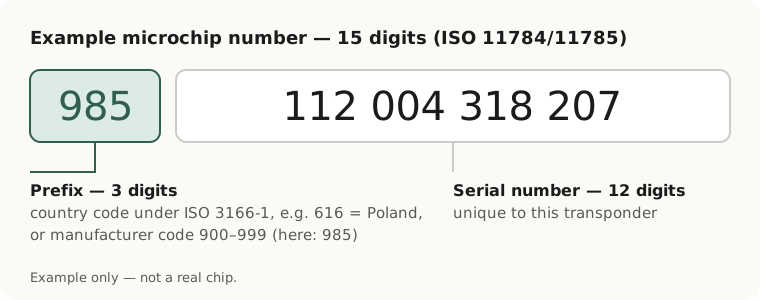
The spaces are only for the eye — in a lookup and in every database it is the string of fifteen digits that counts. The number may also be printed without spaces or with dashes; it is still the same number.
What the first three digits mean
The first three digits are a prefix; the remaining twelve are the serial number of that particular transponder. The prefix is one of two kinds:
- A country code under ISO 3166-1 — it tells you the country the chip was issued for, e.g. 616 Poland, 276 Germany, 826 United Kingdom, 040 Austria.
- A manufacturer code in the range 900–999 — e.g. 985, 981 or 900. It identifies the company that made the chip, not the country where it was implanted.
The prefix does not tell you which database the dog is registered in, nor who the owner is. A chip with the Polish code 616 may be registered abroad, and a manufacturer chip starting with 985 may be registered in Poland. The prefix is only a hint about where to look; only the lookup result tells you about the registration.
Older and unusual numbers
Before the ISO standard became widespread, chips with 9- or 10-character numbers were used, sometimes containing letters. You will mostly meet them in older animals and in animals brought over from the United States. Such a number can still be checked, but not every scanner reads these chips — if your dog has one, ask your vet about a universal scanner.
How to read a chip when you have no documents
A microchip number can only be read with a scanner (an RFID reader). You will find one at:
- any veterinary clinic — the reading takes seconds and is usually free or costs very little,
- animal shelters and rescue centres,
- dog wardens, municipal animal services and many animal charities.
The scanner is passed over the neck and between the shoulder blades; chips sometimes migrate under the skin, so a thorough scan also covers the sides and chest.
A microchip has no GPS. This is the most common misunderstanding. The transponder has no battery, sends no signal and cannot locate your dog. It wakes up for a fraction of a second when a scanner is a few centimetres away and hands over its number — that is all. The chip helps once somebody finds the dog, scans it and checks the number in a database, which is why registration matters so much. If you want to track your dog on a map, you need a separate GPS tracker on the collar.
What to do with the number
Check whether it is registered
Enter the number in the DogWorldBase microchip lookup. You will see whether it is in our registry and whether partner registries recognise it. What an empty result means and how to register — step by step in how to check if my dog's microchip is registered.
Keep it somewhere safe
Take a photo of the barcode sticker and save the number in your phone, so you are not hunting for the booklet in a panic if the dog ever goes missing.
Do not publish the microchip number
The chip number is your dog's identifier and should stay between you, your vet and the registry. Do not put it in lost-pet posts, on social media or in sale listings — with the number in hand, a stranger could try to register the dog as their own or pose as the owner. “Microchipped and registered” is all a post needs to say; a finder will read the number at the vet anyway. On DogWorldBase the chip number never appears on any public page.
A cat's microchip number
For cats everything is the same: the same type of transponder, the same 15 digits, the same entry in the passport or booklet, the same scanner. Cats are often chipped during neutering, so look for the number in the paperwork from that procedure too. Checking and registering a cat's chip works in the same lookup as for dogs.
More short answers — how many digits, is the lookup free, will you see the owner's details — are in our microchip FAQ.